IPTV Ireland has changed a lot in a few years. Fibre broadband has reached towns and villages that used to struggle with a single bar of signal, Smart TVs are in almost every sitting room, and more households are asking the same question: do we still need a satellite dish and a long contract to watch the telly?
This guide answers that question from an Irish point of view. Instead of a generic explanation of internet TV, you’ll learn what picture quality to expect from the broadband you actually have, how the Irish sporting year affects streaming, which devices make sense, and how to avoid the common mistakes. Whether you live in Dublin 3 or a village in Sligo, you’ll finish knowing whether IPTV is right for your home.
Key takeaways
- IPTV delivers live TV and on-demand content over your broadband instead of a dish or aerial.
- Most Irish fibre and part-fibre connections are fast enough for HD, and many handle 4K easily.
- Rural homes on wireless or mobile broadband can still enjoy IPTV with the right settings.
- Plan around the Irish sporting calendar: the busiest viewing days are the real test of any service.
What Is IPTV, in Plain Irish English?
IPTV stands for Internet Protocol Television. In simple terms, the pictures that used to arrive through a satellite dish or a rooftop aerial now arrive through your broadband instead. An app on your TV, Firestick, box or phone receives the stream and plays it, much like Netflix or the RTÉ Player, except that it includes live channels and a full programme guide as well as films and series.
For IPTV Ireland users, that has three practical consequences. First, there’s no installation visit: if you have broadband and a compatible device, you can be watching within minutes. Second, you can watch on more than one screen, including phones and tablets around the house. Third, your picture quality depends on your internet connection, which is why the next section matters so much.
IPTV Ireland and Your Broadband: What Quality to Expect
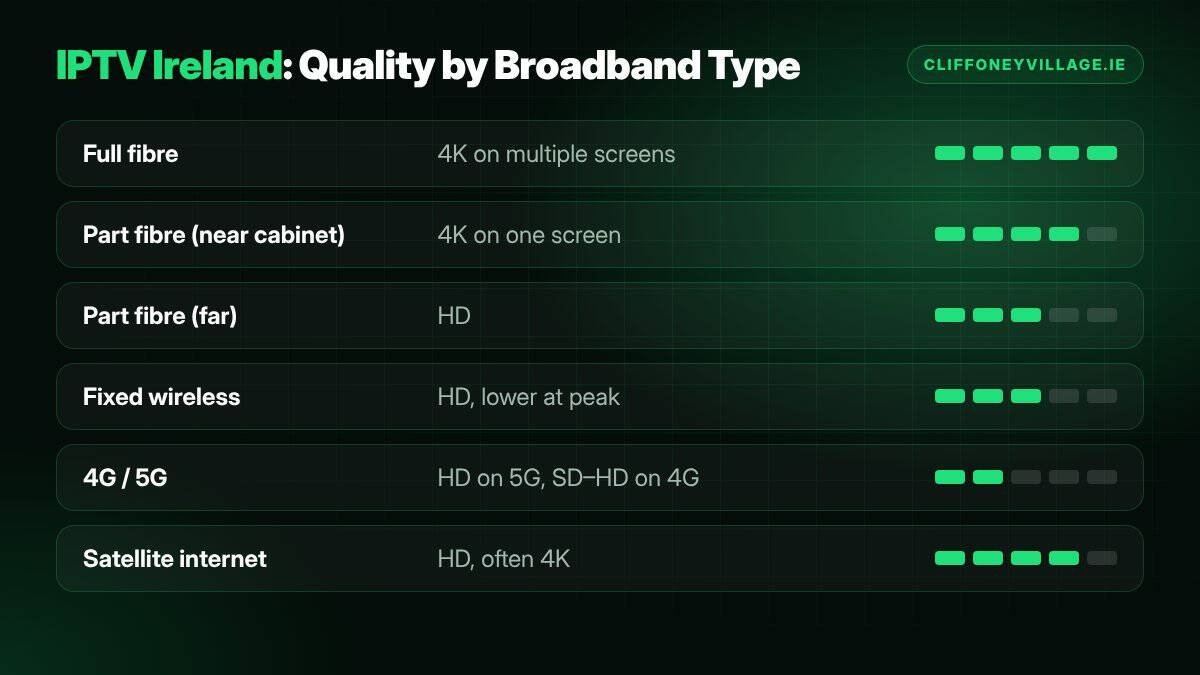
IPTV Ireland homes use a mix of connection types, and each one behaves differently. The speeds below are typical, not guaranteed, so always run a speed test on the device you’ll watch on.
Full Fibre (Fibre to the Home)
Full fibre runs a fibre-optic line right into your house. It’s increasingly common in cities and, thanks to the national rollout, in many rural areas too. Speeds of 150 Mbps and well beyond are normal. For IPTV Ireland purposes, full fibre is ideal: 4K on several screens at once is comfortably within reach.
Part Fibre (Fibre to the Cabinet)
Part fibre uses fibre as far as a green cabinet on the street and copper phone wire for the last stretch. Speeds depend heavily on how far your home is from the cabinet. Close by, you may get well over 50 Mbps; further away, it can drop considerably. Most part-fibre homes stream HD without trouble, and many can manage 4K on one screen.
Fixed Wireless Broadband
Common in rural Ireland, fixed wireless uses an antenna on your house pointed at a nearby mast. Performance varies with distance, weather and how many neighbours share the mast. HD is usually achievable. Choose a lower quality setting during busy evenings if you see buffering.
4G and 5G Mobile Broadband
Mobile broadband can work surprisingly well for IPTV Ireland viewers, particularly on 5G. The catch is variability: speeds can swing during the day, and some plans have data limits. HD streaming uses a lot of data, so check your allowance before you rely on mobile broadband for daily viewing.
Satellite Internet
Modern low-orbit satellite internet has become a real option in very remote areas, often delivering speeds comparable to fibre. It handles HD and frequently 4K, though latency and occasional drop-outs can affect live channels.
| Connection type | Typical experience | Best quality setting |
|---|---|---|
| Full fibre | Fast and very stable | 4K on multiple screens |
| Part fibre (close to cabinet) | Fast and stable | 4K on one screen, HD on others |
| Part fibre (far from cabinet) | Moderate | HD |
| Fixed wireless | Varies with weather and load | HD, lower at peak times |
| 4G / 5G | Good but variable; watch data caps | HD on 5G, SD–HD on 4G |
| Satellite internet | Good speeds, occasional drop-outs | HD, often 4K |
If you’re unsure what you have, your provider’s account page or bill will say. The communications regulator, ComReg, also publishes consumer information about broadband services in Ireland.
The Irish Sporting Calendar: When IPTV Gets Tested
Sport drives IPTV Ireland viewing more than almost anything else, and sport is the hardest thing to stream because it’s live and everyone watches at once. Understanding the calendar helps you plan trials, choose plan lengths and set expectations.
Spring: Six Nations, League Finals and Cheltenham
February and March bring the Six Nations, with packed pubs and full sitting rooms. The GAA leagues reach their business end around the same time, and the Cheltenham Festival in March is a huge racing week for Irish viewers. It’s one of the busiest stretches of the IPTV Ireland year.
Summer: Championship Season
From the provincial championships through to the All-Ireland finals, summer weekends are dominated by hurling and football. The Galway Races, usually around the turn of July and August, add another peak. If you want to test a service properly, a championship Sunday is the perfect exam.
Autumn and Winter: Premier League, Europe and Christmas Racing
The Premier League runs from August to May, with Saturday afternoons and big midweek nights putting steady pressure on servers. November usually brings rugby internationals, and the Leopardstown Christmas Festival fills the days after Christmas.
The lesson for IPTV Ireland households is simple: the service you choose must cope on these days, not just on a quiet Tuesday. Our 30-minute IPTV trial plan shows you how to test exactly that.
Irish Channels, Guides and Time Zones
An IPTV service built for Irish homes should make Irish channels easy to find. RTÉ One, RTÉ2, Virgin Media One, TG4 and other national channels should sit in their own clear category, alongside UK and international options.
Pay attention to the electronic programme guide too. Ireland switches between Greenwich Mean Time in winter and Irish Standard Time in summer, and a guide that doesn’t adjust properly will show every programme an hour out. It sounds minor, but it’s the kind of daily irritation that makes people give up on a service. Checking the guide is part of any sensible IPTV Ireland test.
Which Devices Work Best for IPTV in Ireland?
You probably already own something that can run IPTV Ireland services. Here’s how the common options compare for Irish homes.
| Device | Strengths | Things to know |
|---|---|---|
| Amazon Fire TV Stick | Cheap, easy, plugs into any HDMI port | 4K models handle IPTV best; older sticks can feel slow |
| Samsung / LG Smart TV | No extra box, one remote | App choice depends on the TV’s operating system |
| Android TV box | Flexible, wide app choice, Ethernet port | Quality varies; buy a reputable brand |
| Apple TV | Smooth, premium experience | Higher upfront cost |
| Phone or tablet | Watch anywhere in the house or on the go | Small screen; uses mobile data outside Wi-Fi |
For a step-by-step walkthrough on each of these, see our IPTV service setup guide.
IPTV Ireland vs Traditional TV Packages
Traditional satellite and cable packages still suit some households compared with IPTV Ireland options, especially those who want one bill from one big company. But many Irish viewers are switching for reasons that have nothing to do with technology:
- No contract: prepaid IPTV plans let you choose how long you stay.
- No installation: nobody needs to climb onto your roof or drill through your wall.
- More screens: watch in the kitchen, the bedroom or on the train.
- Clearer pricing: with a good provider, the price includes sport and films with no extra packs.
The trade-off is that your picture depends on your broadband. If your connection is weak, a dish may still be more reliable. That’s exactly why a free trial matters before you switch. For a detailed look at value, read our guide to IPTV subscription costs.
Getting the Best IPTV Ireland Picture on Rural Broadband
Rural homes are often told that streaming “won’t work out here”. In reality, many rural IPTV Ireland viewers get an excellent picture once a few settings are right.
- Choose HD over 4K at peak times. A steady HD picture is far better than a 4K picture that keeps stopping.
- Use a cable from the router. Wireless broadband already uses one wireless hop; avoid adding a second one through weak indoor Wi-Fi.
- Increase the player’s buffer. A larger buffer smooths over the brief dips common on fixed wireless and mobile connections.
- Check for a fibre upgrade. The national rollout has reached many rural areas, so it’s worth checking whether full fibre is now available at your address.
With those tweaks, IPTV Ireland viewing on rural broadband is usually reliable enough for daily use, including live sport.
Is IPTV Legal in Ireland?
IPTV itself is simply a way of delivering television over the internet, and major broadcasters use it every day. What matters legally is whether the content you watch is licensed for distribution. Choose a provider that is open about licensing, publishes clear terms and conditions and gives you a business name and address before you pay. Those are signs of a service that takes its obligations seriously.
How Much Does IPTV Ireland Cost?
Prices vary widely, so it’s worth knowing what’s normal. Most IPTV Ireland services sell prepaid plans of one, three, six or twelve months. Monthly plans give flexibility; annual plans give the lowest price per day. At Cliffoney Village IPTV, for example, a single month is €14.99, while the 12-month plan works out at roughly €4.17 a month, or about 14 cent a day.
Beyond the subscription itself, think about the total cost. If you already have a Smart TV, there may be nothing else to buy. If not, a streaming stick is a one-off purchase. Your broadband bill stays the same, because IPTV Ireland viewing uses the connection you already pay for. For a full breakdown of plan lengths and savings, see our IPTV subscription cost guide.
IPTV Ireland in a Typical Irish Home: A Walkthrough
To make this practical, picture a family of four in a semi-detached house outside a midsized Irish town, on part-fibre broadband averaging around 60 Mbps. Here’s how they might set things up.
The Living Room
The main Smart TV runs the IPTV app directly. Because the router is in the hall, they run a long flat Ethernet cable under the carpet. The TV now gets a rock-solid connection for 4K films and live sport, which is where IPTV Ireland viewing matters most in this house.
The Kitchen
A tablet on the counter streams the news and the radio-style music channels in HD over Wi-Fi while dinner is on. No extra hardware is needed.
The Teenagers’ Rooms
Each has an older TV with a Fire TV Stick plugged into the HDMI port. On Wi-Fi, these run happily in HD. During big matches, the family agrees that only the living room uses 4K, which keeps everything smooth.
The Result
Four screens, no dish, no contract and one predictable price. This is the kind of everyday setup that makes IPTV Ireland so popular: it fits around the house you already have rather than forcing you to rebuild it.
IPTV Ireland for Different Kinds of Viewers
Sports-First Households
If the telly is mainly for matches, prioritise stability over channel count. Test during a live fixture and use a wired connection for the main TV. Sport is where IPTV Ireland services prove themselves or fall short.
Older Viewers
Simplicity matters most. Choose a provider that offers patient, step-by-step setup help, and a device with a straightforward remote. A Smart TV app or a Fire TV Stick is usually the easiest option.
Students and Renters
No installation means nothing to leave behind when you move. A streaming stick and a monthly or three-month plan give maximum flexibility for people who change address often.
Film and Series Fans
Look at the on-demand library as closely as the live channels. Check how series are organised, whether subtitles are available and how quickly titles start. For many IPTV Ireland users, video-on-demand ends up being watched more than live TV.
Common IPTV Ireland Mistakes to Avoid
Putting the Router in the Wrong Room
Thick walls are common in Irish houses, and they block Wi-Fi. If your router lives in the hall and your TV is in the back room, use an Ethernet cable, a powerline adapter or a mesh Wi-Fi system.
Choosing a Service on Channel Count
Forty thousand channels mean nothing if the ten you watch keep freezing. Stability, an accurate guide and helpful support are what make IPTV Ireland worth it.
Buying a Year Before Testing
Annual plans offer the best value, but only once you know the service suits your home. Test first, then commit.
Ignoring the Data Cap on Mobile Broadband
HD streaming uses gigabytes per evening. If you’re on capped 4G, check your allowance or lower the quality to avoid a nasty bill.
A Simple IPTV Ireland Checklist Before You Switch
- Run a speed test on the device you’ll watch on.
- Decide which devices and rooms you want to watch in.
- List the channels and sports your household can’t live without.
- Shortlist two or three providers and ask them the right questions. Our IPTV provider checklist has ten you can copy.
- Run a structured free trial during a live event.
- Start with a shorter plan, then move to annual once you’re happy.
Try IPTV in your own Irish home
Cliffoney Village IPTV offers Irish, UK and international channels, live sport and a big on-demand library, with a free 30-minute trial and no card details needed.
IPTV Ireland FAQs
Does IPTV work in rural Ireland?
Yes, in most cases. Full fibre is increasingly available in rural areas, and fixed wireless, 5G and satellite internet can all support HD streaming with the right settings.
What speed do I need for IPTV in Ireland?
Around 10 Mbps for HD on one screen and 25 Mbps or more for 4K. Add more headroom if several people watch at once.
Can I watch Irish channels on IPTV?
A good IPTV Ireland service includes Irish channels in a clear category, with a programme guide set to Irish time.
Do I need a satellite dish for IPTV?
No. IPTV uses your broadband connection, so there’s no dish, aerial or installation visit required.
Is IPTV cheaper than a traditional TV package?
Often, yes, especially on longer prepaid plans. Compare the full price including sport and films, and remember there’s no contract or equipment rental with most IPTV plans.
Final Thoughts
IPTV Ireland is no longer a niche for tech enthusiasts. With fibre spreading across the country and Smart TVs in most homes, it’s a practical, flexible way to watch everything from the evening news to the All-Ireland final. Check your broadband, choose your device, test properly during a busy live event, and you’ll know within an hour whether it’s right for your household. Questions? Talk to our team on WhatsApp and we’ll help you work it out. We’re happy to look at your broadband speed, your devices and the sport you follow, and tell you honestly what kind of picture to expect before you spend anything.